

By Nick Ruddle · Specialist landscape business coach since 2007
Promoting a Landscape Team Leader: A Practical Checklist
Before promoting a landscape team leader, check planning, delegation, communication and judgement. Use this practical checklist to build a supported start.
A reliable landscaper may be the person you trust with difficult work. Before asking them to run a crew, check whether they can also plan the day, explain the standard and help other people deliver it.
Promoting a landscape team leader works best when the responsibilities are clear and the person has support to grow into them. Use the checks below to prepare for that conversation and build a practical development plan.
Start by defining the role you need
Write down what you expect the team leader to own. “Take charge of the site” leaves too much open to interpretation.
For a landscaping crew, the role might include:
- Preparing the daily work plan from the agreed job information.
- Briefing the crew and allocating work within each person's competence.
- Checking workmanship at agreed stages.
- Recording progress, delays and materials needed.
- Handling routine client updates within an agreed scope.
- Raising safety concerns, changes and decisions outside their authority promptly.
Then list what stays with you or another manager. That could include approving variations, agreeing prices, making contractual commitments and handling formal employment matters.
HSE's guidance on supervision highlights the need for defined responsibilities, suitable skills, support and enough time to supervise. Treat those as foundations when designing the role. A new title does not create extra hours in the working day.
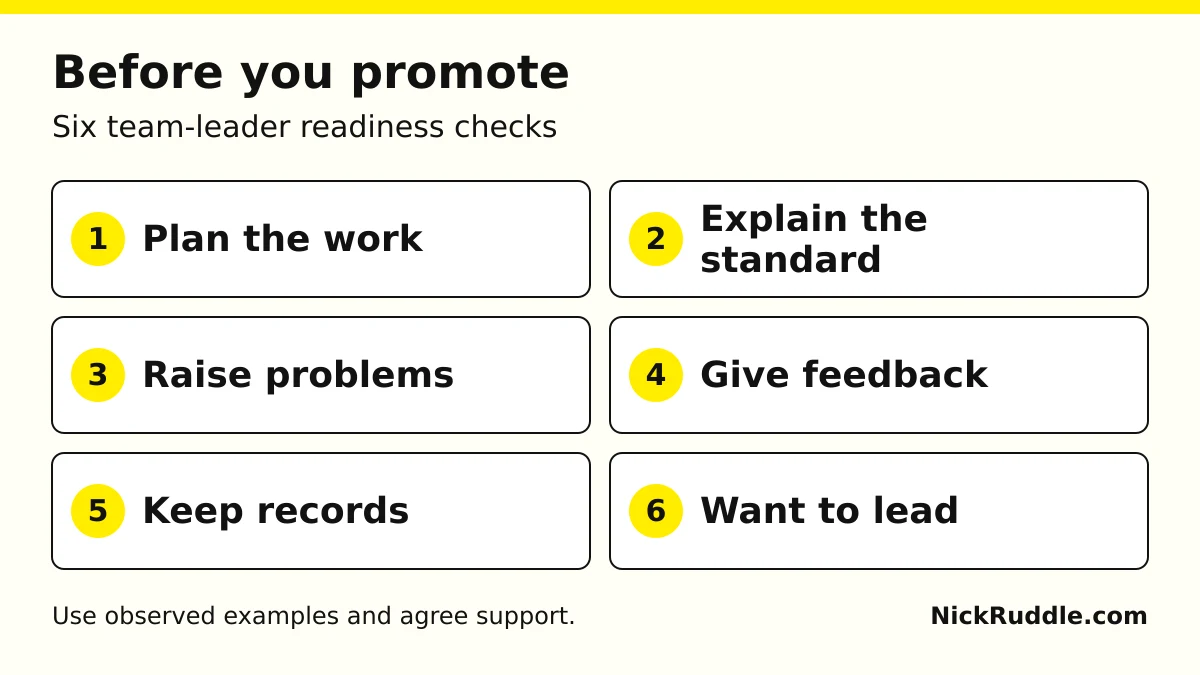
Six checks before promoting a landscape team leader
1. Can they turn job information into a workable plan?
Ask the person to talk through the next stage of an upcoming job. What needs to happen first? Which materials, equipment or decisions must be available? What might prevent the crew from starting?
Look for preparation rather than a promise to work harder. A useful response identifies dependencies, checks missing information and explains who needs to do what.
For grounds maintenance, use a real round: access arrangements, expected standards, equipment availability and the work that needs to be completed at each site. The same planning habit applies, even when the jobs repeat.
2. Can they explain the standard without taking over?
A capable team leader needs to help others understand the job. Ask them to explain an appropriate task to a colleague, including the expected result and the point at which it should be checked.
Notice whether they invite questions and confirm understanding. Do they give the colleague room to work, or immediately take the task back?
Choose work that is suitable for the colleague's training and competence, with the supervision it requires. A development exercise should never become a reason to leave someone doing unfamiliar or unsafe work alone.
3. Do they raise problems early and clearly?
Use a hypothetical situation: the delivered paving does not match the specification, and the client suggests using it anyway to avoid a delay.
A useful response would explain the mismatch, check the agreed specification, protect the work from an unapproved change and contact the person authorised to decide. It would also consider what other work can safely continue.
The aim is sound judgement within clear boundaries. “I sorted it” is not enough if sorting it meant agreeing an extra cost or changing the scope without approval.
4. Can they give calm, specific feedback?
Ask how they would handle a colleague repeatedly leaving an agreed quality check unfinished.
Look for a conversation about the observed work, the expected standard and what needs to happen next. They should also listen: missing information, equipment or training may be contributing to the problem.
Agree which everyday conversations they can handle and which concerns they should refer to you. Formal disciplinary issues need the business's proper process, rather than an improvised response on site.
5. Will they keep useful records?
Give them the reporting format the business actually uses. Ask for a short example covering work completed, hours recorded, problems, approved changes and requirements for the next day.
A useful report lets someone else understand the situation without a series of follow-up calls. Avoid rewarding a long report that says little. Focus on accurate information that helps the office, estimator or next crew make a decision.
If records are difficult to produce, check your own system before judging the person. They need a clear format, access to the right information and time to complete it.
6. Do they want to lead people?
Have a direct conversation about the work involved. Explain the planning, communication and follow-through expected alongside practical landscaping.
Ask which parts appeal to them, where they feel confident and what support they would need. Being an excellent craftsperson does not mean someone wants a supervisory role. That conversation helps you plan a development route that fits both the person and the business.
Record evidence, not just an overall impression
For each of the six checks, make a short note under four headings:
- Observed example: What did the person actually do?
- Current support: Where did they need help?
- Next practice task: What suitable responsibility will they practise?
- Review date: When will you discuss what happened?
Use “ready with support”, “needs further practice” or “not yet observed” if those descriptions help. Do not turn an unchecked box into an assumption that the person cannot learn. Equally, do not treat a strong score in communication as a substitute for the technical and safety competence required by the work.
Give them a supported start
Agree a development period with responsibilities that match their current competence. This is a practical coaching plan, not a substitute for any employment arrangements or role-specific training your business needs.
Before the first day, confirm:
- The jobs and people they are responsible for.
- The decisions they can make and the limits on those decisions.
- The checks and reporting you expect.
- Who they should contact for help and how urgent issues are escalated.
- The time allowed for planning, supervision and administration.
Hold a short weekly review. Discuss one decision that went well, one situation that was difficult and one thing to practise next. Share your notes so the person knows what you agreed.
Acas guidance on performance reviews recommends regular feedback and check-ins alongside formal reviews, with objectives that fit the person's responsibilities and workload. Use that approach to make development specific rather than waiting for a problem to trigger a conversation.
Check whether your own habits support the role
If the crew continues to bring every routine decision to you, ask whether you have clearly explained the team leader's authority. If you keep changing their plan without discussion, clarify how decisions will be made.
Support the role publicly and coach privately where appropriate. Step in immediately when safety or another serious concern requires it. Otherwise, help the team leader work through the decision instead of automatically taking it back.
For the wider job-planning issues behind delays, see how to improve garden team productivity.
Build the leadership skills the role needs
A promotion should come with a clear development plan. Team Leader & Manager Training for Landscape Businesses covers planning, delegation, communication and handling everyday people challenges. Review the programme and ask about suitability, current dates and fees.
Leadership development complements the technical instruction, qualifications and health and safety training needed for the work. If the bigger challenge is your own management structure or delegation as the owner, explore one-to-one landscape business coaching.
Want to apply these ideas in your landscape business?
Book a discovery call →