

By Nick Ruddle · Specialist landscape business coach since 2007
How to Choose a Landscape Business Peer Group
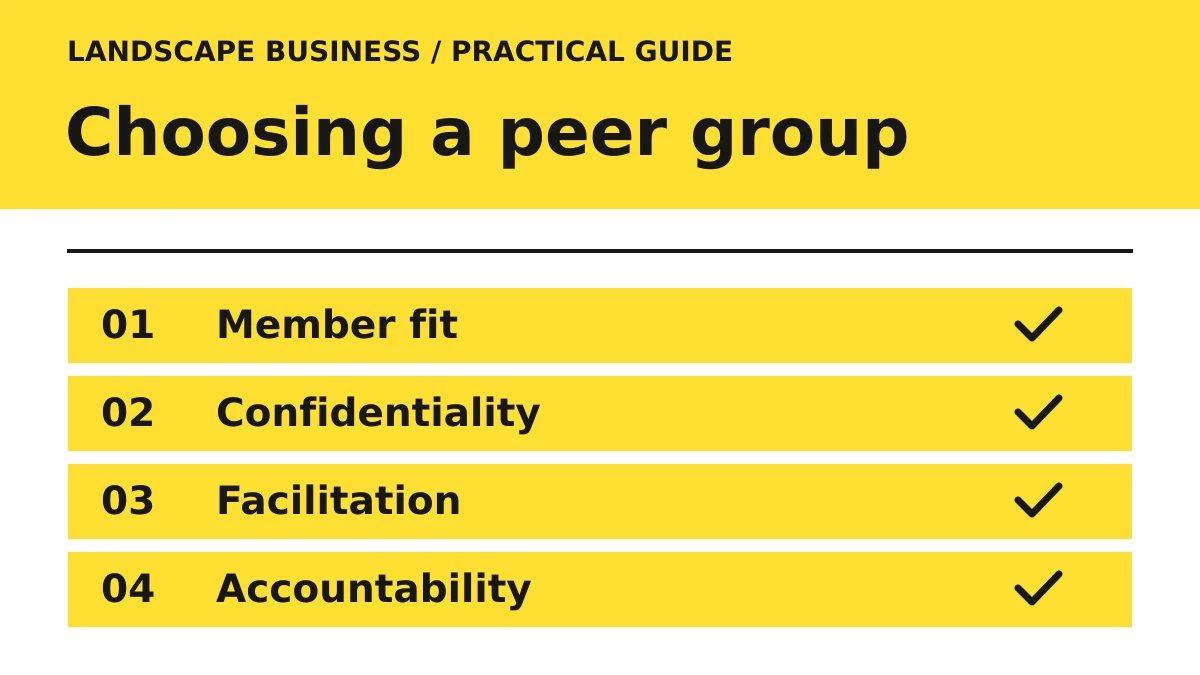
Choosing a landscape business peer group? Check member fit, confidentiality, facilitation and accountability before committing your time and money.
Running a landscape business means making decisions that your team may not be able to help you work through. You might be wondering whether to appoint a manager, how to reduce your involvement in daily problems or why a fuller order book has not made the business easier to run. A peer group gives you a place to explore those questions with other owners. Choosing the right group starts with understanding what you need from it.
Before comparing memberships, write down one decision you want to make and one habit you want to change. Those two answers will help you assess whether a group offers useful support or simply another meeting in an already busy diary.
Start with the challenge you want to work on
“Grow the business” is too broad to judge a programme against. Try to describe the problem you would bring to your first meeting. Perhaps supervisors still pass routine decisions back to you. Perhaps enquiries are coming in, but you struggle to understand which work is worth pursuing. Perhaps you know your priorities but keep putting them behind urgent client demands.
A peer group can give you different perspectives and a regular reason to follow through. You still own the decision and the work afterwards. If you need someone to investigate your business in depth, work privately on a sensitive issue or provide specialist professional advice, ask whether a different kind of support would be more suitable.
Look beyond turnover when assessing the members
Revenue gives you a starting point, but two businesses of similar size can present very different management challenges. One may have several crews and a strong office team. Another may still rely on the owner for estimating, scheduling and client communication.
Ask how members are selected and what stage of business they are at. Think about management structure, service mix, complexity and the decisions owners are making. You want enough common ground for people to understand the problem, with enough difference for them to offer a perspective you have not considered.
Contribution matters too. A useful group needs members who will ask questions, listen and explain what they have learned. If your main aim is to find customers or referral partners, a networking group may fit that aim more closely.
Ask how the conversation is facilitated
The quality of a meeting depends partly on what happens when a discussion becomes vague, one person dominates or everyone agrees too quickly. Ask the facilitator how they make space for members, help someone define their actual question and turn discussion into a practical next step.
You can test the explanation with a hypothetical example: “I am thinking about promoting a team leader, but I am not sure they are ready. How would we work through that?” A useful answer should describe a process for exploring the decision, rather than promise that the group will supply the right answer.
Peer learning has also been used in public business-support programmes. The government's Peer Networks evaluation covers a programme that combined action learning with one-to-one support between 2020 and 2022. That is background on the approach, not evidence of results for any particular current group.
Be clear about privacy and boundaries
Ask what confidentiality arrangements apply and how the group handles potential conflicts between members. Check what is expected when someone brings an example involving a client or employee. You should be able to discuss the management challenge without circulating names, private documents or unnecessary personal information.
Also ask whether any competitor-matching policy applies only to your private group or to wider events. These are different arrangements. Get the details before relying on a broad description such as “exclusive” or “confidential”.
Check what happens after the meeting
An interesting discussion is only part of the value. Find out how members record commitments and review them next time. Keep your own actions small enough to complete alongside running the business.
For example, a hypothetical first commitment might be to record the routine decisions that come back to you over one working week. You could then agree which decisions a manager can own, what information they need and when they should involve you. At the next meeting, you have something specific to discuss: what you changed, what happened and where you still need help.
Useful measures depend on the decision. They might include time spent on repeated approvals, whether job information is ready before the crew arrives, or whether agreed actions were completed. Choose a measure you can record consistently, rather than collecting a dashboard full of numbers you never use.
Compare the whole commitment
Before joining, check meeting dates, preparation time, travel, fees, what support is included and the joining and cancellation terms. Ask what happens if you miss a session, when a proposed group will actually start and what conditions must be met first.
Put the preparation and follow-up time in your diary as well as the meetings. If you cannot protect that time, consider whether this is the right moment to join. Equally, if being constantly busy is the problem you want to tackle, use the suitability conversation to explain that clearly.
Decide what would make membership worthwhile
Finish by writing a short description of the progress you want to review after your first few meetings. It could be a clearer management structure, a decision you have been avoiding or a more consistent habit of working on priorities. Avoid judging the group solely by how motivated you feel at the end of a session.
If you are considering a facilitated group for your landscape business, review the Landscape Business Peer Groups programme. The programme page explains current group availability, matching, format and what membership includes. If you would prefer focused work on your own business, compare that with the one-to-one coaching options.
The useful question is straightforward: will this arrangement help you make better-informed decisions and carry out the work you have agreed to do?
Want to apply these ideas in your landscape business?
Book a discovery call →