

By Nick Ruddle · Specialist landscape business coach since 2007
Artificial Intelligence Implementation Roadmap
Build an artificial intelligence implementation roadmap for your landscape business, from commercial priorities and pilot systems to measurable gains.
A missed enquiry at 7pm, a quote that waits three days for revision, and a site manager chasing job details across WhatsApp can each cost more than a new piece of machinery. For a growing contractor, an artificial intelligence implementation roadmap is not about buying fashionable software. It is about removing the points where slow decisions, inconsistent follow-up and owner dependency restrict profit.
Landscape businesses are particularly well placed to benefit because much of the work is repeatable but information-heavy. Enquiries need qualifying, estimates need structuring, customers need reassurance, teams need clear instructions, and directors need visibility of work in the pipeline. AI can improve each of these areas, but only when it is introduced around a clear commercial plan.
Start with the commercial constraint, not the technology
The wrong starting point is asking, “Which AI tool should we use?” The better question is, “What is currently stopping this business from converting, delivering or retaining more profitable work?” A garden construction firm may have a full diary but weak margins because estimates are rushed. A grounds maintenance business may lose opportunities because nobody follows up seasonal tender enquiries quickly enough. A design-and-build company may be relying on the owner to answer every client question.
Choose one constraint that has a measurable financial or operational consequence. It might be quote turnaround time, enquiry-to-survey conversion, average contract value, time spent on administration, overdue payment chasing, or the number of customer updates issued without prompting. If the problem cannot be described in plain terms and measured, AI will only add another layer of activity.
This is also where leadership matters. AI should support the company strategy, not become a side project handed to the most tech-confident person in the office. Set the outcome first, appoint an accountable owner, and agree what improvement would justify the time and investment.
Map the work before automating it
Most landscape businesses do not need to rebuild their entire operation. They need to see how work actually moves from lead to completed project or recurring visit. Map the current process, including the informal steps that happen in calls, texts, notebooks and personal inboxes.
For example, a domestic landscaping enquiry may arrive through the website, Facebook, a recommendation or a phone call. Someone responds, gathers basic details, books a visit, prepares a quote, chases a decision, schedules the work, orders materials, updates the client and requests a review. At each stage, identify the delay, duplication or decision point.
AI is effective where there is a repeatable input and a useful output. It can turn an enquiry form into a qualified lead summary, create a first draft of a survey confirmation email, convert site notes into a structured scope of works, or produce a polite follow-up message based on the quote status. It should not be asked to make final promises on price, programme, specification or site risk without experienced human review.
That distinction is vital. The value is not in replacing professional judgement. It is in ensuring the right person spends their judgement where it affects margin, quality and client confidence.
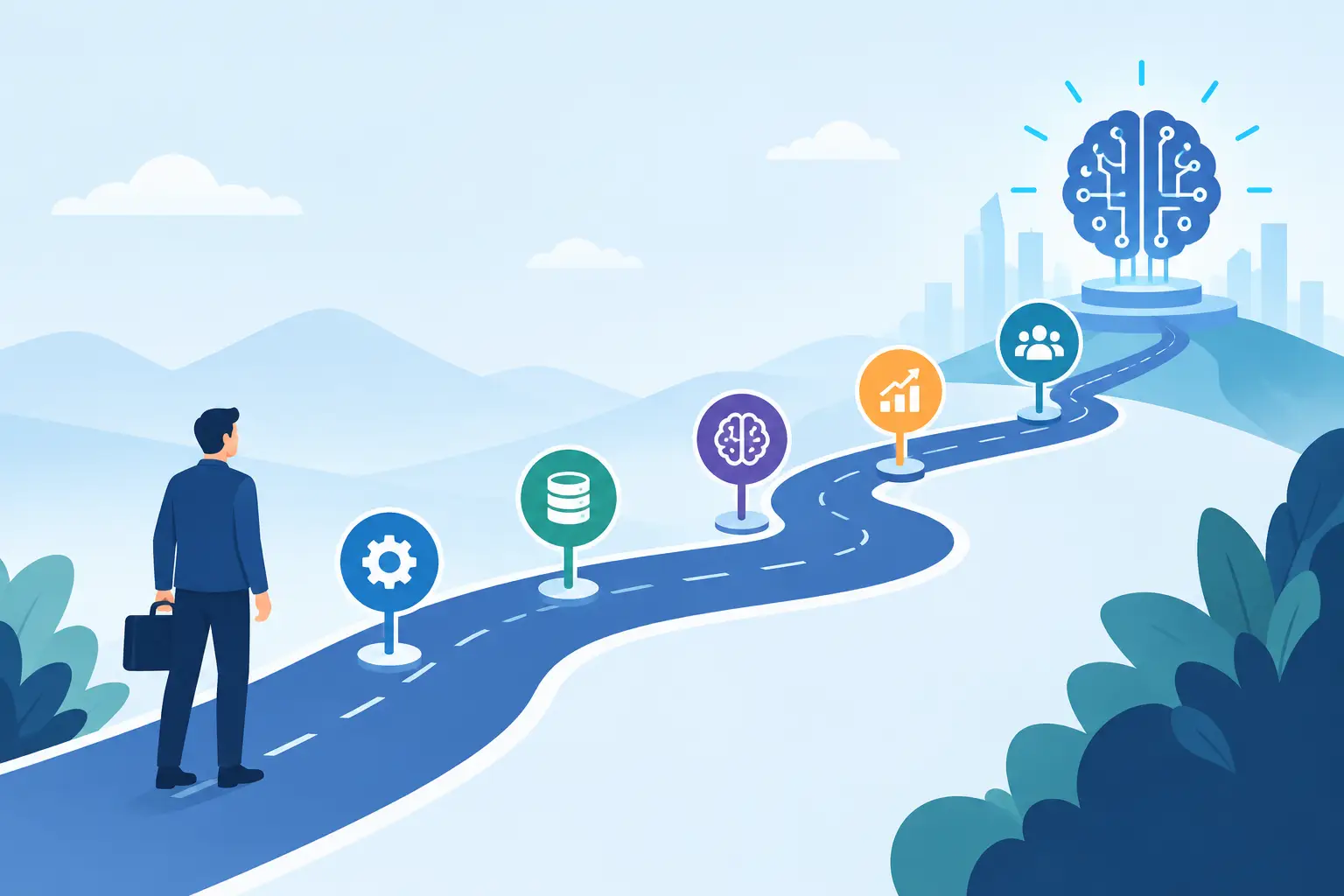
Build the artificial intelligence implementation roadmap in phases
A sensible artificial intelligence implementation roadmap for a landscape business should be phased. This reduces disruption, proves value early and gives the team time to develop better working habits.
Phase one: establish the baseline
Before introducing anything new, record the current position for the chosen process. If the focus is quoting, measure how long it takes from survey to sent quotation, how many quotes receive follow-up, the acceptance rate and the average gross margin. If the focus is lead handling, measure response time, qualified appointments booked and the source of successful jobs.
Review the information already held in your CRM, estimating system, job management platform and email accounts. Poor or fragmented data is not a reason to abandon the project, but it does affect what can be automated safely. A system cannot produce a useful pipeline report if job stages mean different things to different people.
Set rules for customer data, access permissions and approval. UK businesses must handle personal information responsibly. Staff should know what may be entered into an AI system, what must remain in approved business platforms, and when client information needs to be removed or anonymised. Convenience is never a reason to take avoidable data risks.
Phase two: run a focused pilot
Select one workflow that is frequent, contained and commercially useful. Good first pilots include enquiry qualification, quote follow-up, marketing content planning, job handover packs, meeting notes, customer communications or converting maintenance visit notes into reports.
A strong pilot has a clear owner, a small user group and a defined review period. For instance, a maintenance company could use AI-assisted templates to turn supervisor notes into concise client reports for commercial sites. Measure the time saved, the quality of reports, client response and whether supervisors actually use the process after the initial enthusiasm fades.
Do not judge the pilot solely by minutes saved. Faster work that creates errors, weakens the customer relationship or makes staff disengage is not progress. Equally, a pilot may be worthwhile if it saves only modest time but ensures every quote receives an appropriate follow-up within 48 hours. Consistency has commercial value.
Phase three: standardise the winning process
Once a pilot works, document it properly. Define the input required, the prompt or template used, the person who checks the output, where the final version is stored and how exceptions are handled. This turns an individual shortcut into an operating system the business can rely on.
For a garden design-and-build business, this might mean that every survey is recorded using the same headings: client priorities, access constraints, levels, utilities, preferred materials, budget indication and programme expectations. AI can then help draft a coherent internal brief or customer-facing proposal. The estimator still validates quantities, rates, exclusions and buildability, but begins from a more organised foundation.
Training should be practical and role-specific. Your estimator does not need a lecture on machine learning. They need to know how to prepare source information, check an AI-generated draft, protect pricing data and recognise where the result is wrong. The same applies to office staff, contract managers and team leaders.
Phase four: connect systems where it makes sense
Only after a process is proven should you consider broader integration. Connecting enquiry forms, CRM stages, calendars, estimating software and communication tools can reduce repetitive admin, but connections also increase complexity. The right level depends on the size of the business, the reliability of existing systems and the volume of work.
A £1 million turnover contractor with an administrator may gain most from disciplined templates and CRM automation. A multi-team grounds-care operation managing hundreds of recurring visits may justify deeper workflow integration and reporting. There is no prize for having the most complicated technology stack. The objective is a more controlled, more profitable business.
Measure adoption as well as results
The strongest AI projects are managed like commercial improvement projects. Review performance weekly during the pilot and monthly once the process is established. Compare results against the baseline, but also ask whether staff are following the agreed process and whether clients notice an improvement.
Useful measures include response speed, quote conversion, administration hours per job, rework caused by missing information, customer review requests completed, aged debtors and director time removed from routine decisions. Keep the scorecard focused. Too many measures obscure the outcome you are trying to improve.
Expect adjustment. A prompt that works for small domestic projects may be unsuitable for complex commercial landscape packages. A customer communication workflow may need a different tone for a housing developer than for a private garden client. AI works best when the business refines it from real operational feedback rather than assuming a first version is final.
Keep human accountability where it earns its place
Landscape work is physical, site-specific and dependent on trust. AI can help prepare information, spot patterns and accelerate communication, but it cannot inspect drainage, judge workmanship, negotiate a difficult variation or take responsibility for a promise made to a client.
Use it to make leaders and teams better prepared. Keep commercial approvals, safety decisions, contractual commitments and final quality control with competent people. This balance protects the reputation you have worked hard to build while allowing the business to operate with greater pace and discipline.
The best first move is rarely dramatic. Pick the process that repeatedly steals time or loses opportunities, improve it visibly, and make that improvement the new standard. That is how a landscape business turns AI from a talking point into a lasting commercial advantage.
Want to apply these ideas in your landscape business?
Book a discovery call →